
Extending Flowcrafter
Inbound Triggers
Start workflows from external events with the transport-free External_Triggers API and the generic test-listen lifecycle.
An external trigger starts a workflow after your plugin receives an event. That might be an HTTP webhook, a queue message, or another provider callback. Your plugin owns receiving and authenticating the event; Flowcrafter owns creating the run and executing the workflow.
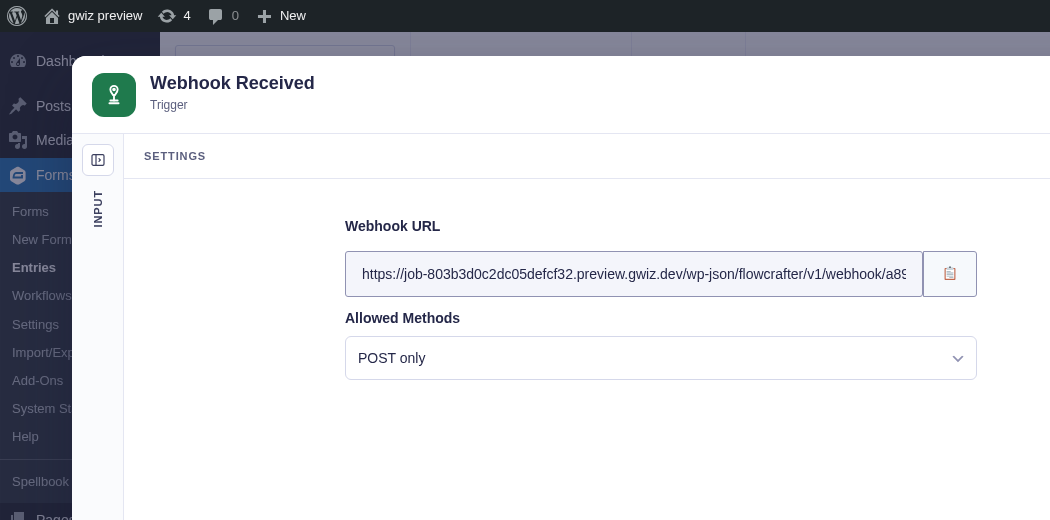
API Alchemist’s Webhook Trigger is a visible reference for an inbound node: it starts an example workflow and exposes its inbound controls in the node window. The URL token visible in this capture was revoked afterward and must not be reused.
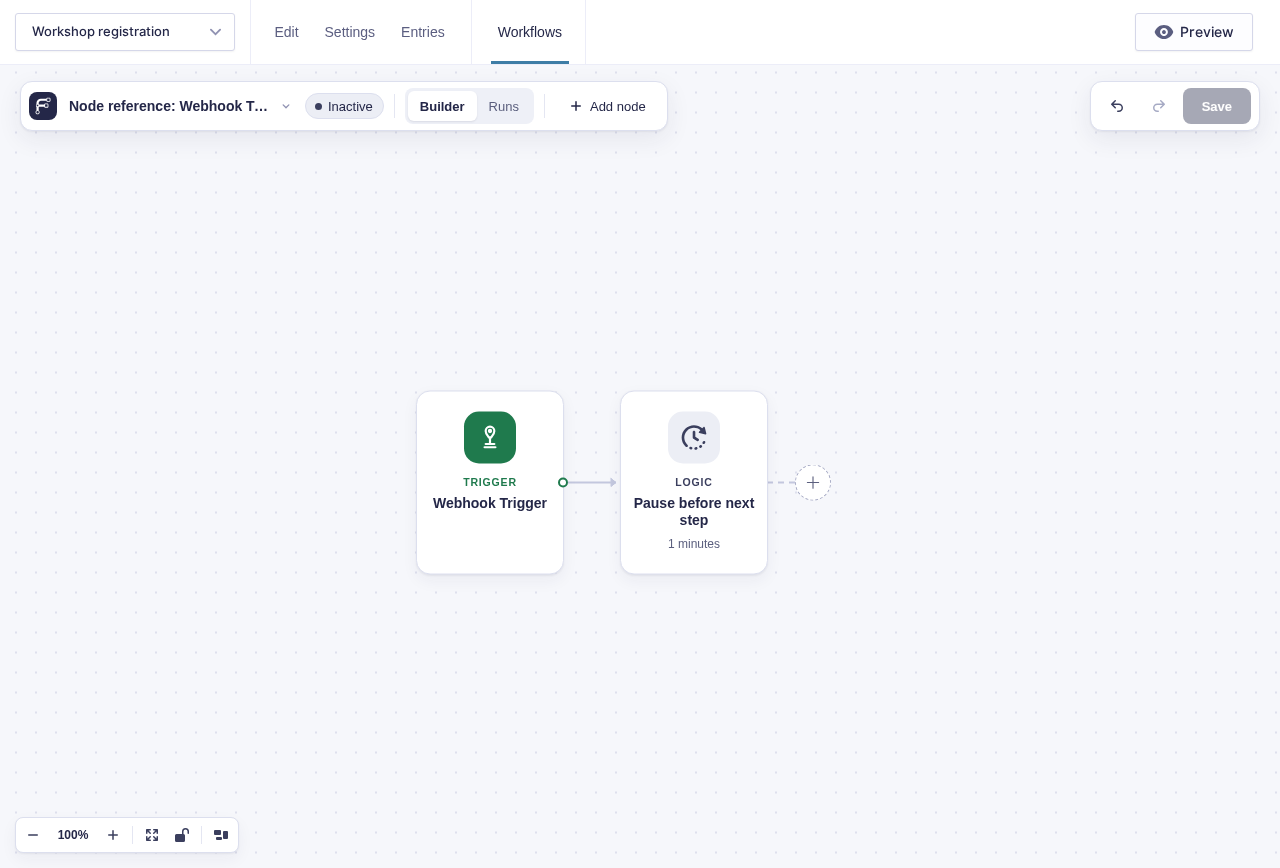
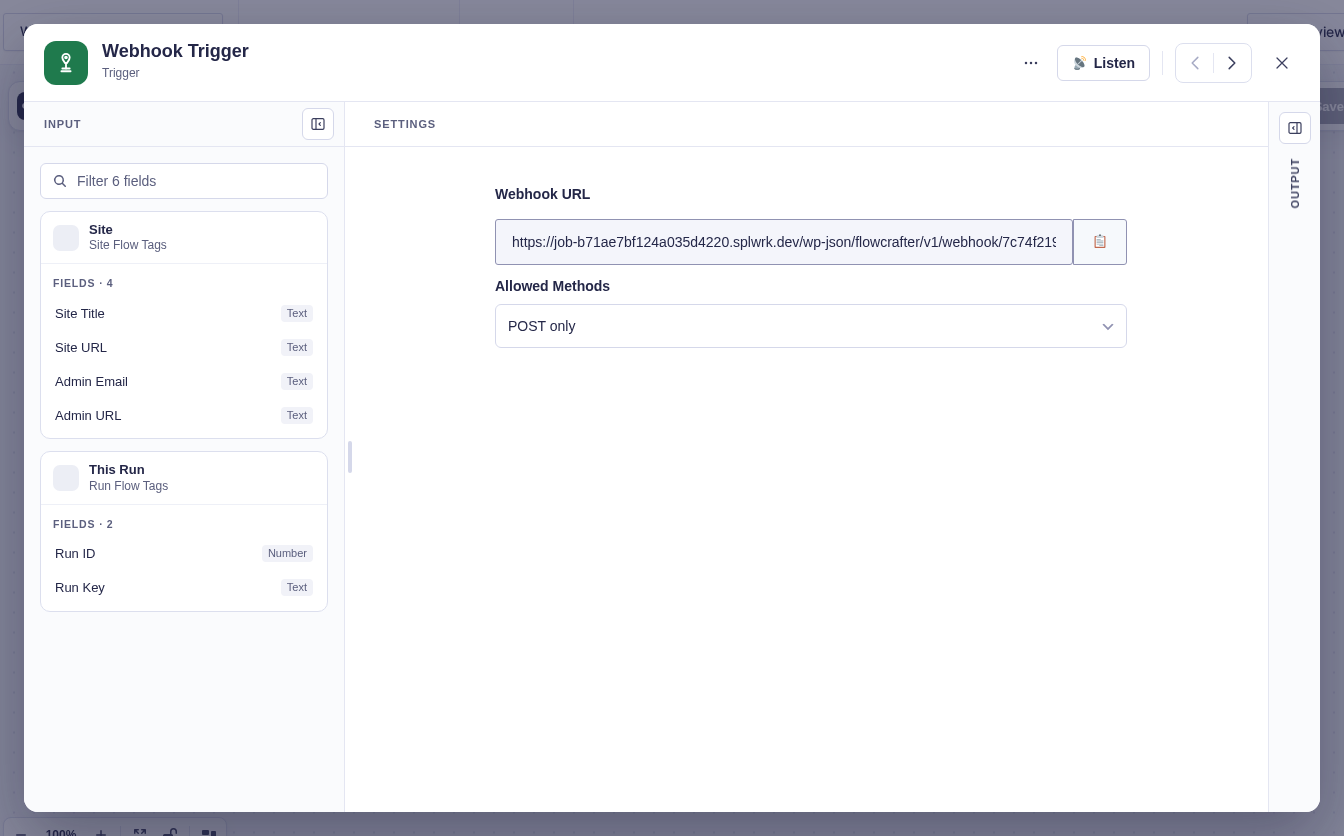
Start a production run
Section titled “Start a production run”Call the API after your provider has authenticated the event and resolved a saved workflow and trigger node. A request key identifies one delivery: send the same key on retries, and a new key for a genuinely new event.
$response = \Flowcrafter\External_Triggers::start( $workflow, $node_id, [ 'event_id' => $event_id, 'body' => $captured_body ], 'provider-event:' . $event_id);| Method | Purpose |
|---|---|
start(Workflow $workflow, string $node_id, array $payload, string $request_key): WP_REST_Response |
Start or deduplicate a production event. |
accept_test(int $run_id, string $node_id, array $payload): ?WP_REST_Response |
Capture one pending frozen test trigger, without fan-out. |
fail_test(int $run_id, string $node_id, Throwable $error, bool $claimed = false): void |
Claim and fail a pending test capture, or record a failure for a claim the caller already owns. |
cancel_test(int $run_id, string $node_id): void |
Cancel a still-pending test node without overwriting a completed or running capture. |
Production success returns run_id and status: accepted. A retry returns the first run’s ID and status: duplicate. Invalid or inactive workflows return 422. The existing Dispatch::TYPE_WEBHOOK_TRIGGER marker is retained so retries still find older deliveries.
The trigger’s execute() method is not called during production acceptance. Core records the supplied payload through Engine::complete_trigger() and fans out through the durable dispatch outbox. Test acceptance instead logs the output and completes only the selected trigger; the builder decides when to step downstream.
An empty array is a valid captured event. Re-running an external-trigger run preserves it just like a non-empty payload; only an absent payload is refused, such as when retention has removed the original node log.
Open and close a test listener
Section titled “Open and close a test listener”Implement both methods of Supports_Test_Listen. The controller supplies the selected node from the test run’s frozen workflow (the copy captured when testing began), including unsaved builder settings.
public function prepare_test_listen( array $node, \Flowcrafter\Workflow_Run $run );public function stop_test_listen( array $node, \Flowcrafter\Workflow_Run $run, string $listener_id ): void;prepare_test_listen() returns a WP_Error or this generic shape. Put provider-specific display fields inside data, not at the top level:
return [ 'listening' => true, 'listener_id' => $listener_id, 'expires_at' => gmdate( 'Y-m-d\TH:i:s\Z', time() + 300 ), 'expires_in' => 300, 'data' => [ 'webhook_url' => $provider_url ],];Core records fc_test_session_{listener_id} with the run ID, node ID, and expiry. It also records the current session for that run/node and schedules flowcrafter_expire_test_session with wp_schedule_single_event(). Provider routing tokens and subscriptions belong in provider-owned storage, not in these generic records.
stop_test_listen() must revoke only the requested listener generation. Compare its ID before removing a shared routing pointer, so delayed cleanup cannot delete a replacement listener. Core calls this method on Stop, expiry, or run cancellation, then cancels a still-pending node only if the session is still current. A failed stop callback is retried. Start and cleanup share a site-scoped lock; providers must not acquire that lock themselves.
When a test event arrives:
- Resolve the provider’s listener record and reject closed or expired generations.
- Load the frozen test node, authenticate the event against its settings, and capture its payload.
- Call
External_Triggers::accept_test($run_id, $node_id, $payload).nullmeans the pending claim was unavailable or the test context was invalid; do not fan out or overwrite the node yourself. - Close the provider listener after receipt. Core session cleanup remains safe to call again.
- If provider capture throws, call
fail_test()without claiming a node yourself. An ordinary sender-authentication error should normally leave the listener open for a valid event.
accept_test() requires a registered Is_Trigger handler implementing Supports_Test_Listen, claims the pending node atomically, and records its output once. fail_test() cannot steal another request’s running claim unless the caller explicitly passes claimed: true for a claim it owns.
HTTP providers and routing tokens
Section titled “HTTP providers and routing tokens”Flowcrafter does not register a public inbound HTTP route. GC API Alchemist owns Webhook Trigger’s endpoint, sender checks, payload normalization, idempotency-header selection, and token/listener transients. Its production and frozen-test evaluations are independent: a test failure must not replace a successful production response or prevent production dispatch.
Has_Inbound_Token remains useful for providers with token-bearing nodes. Core backfills tokens on save, indexes them for routing, and regenerates them when copying a workflow. If a provider is unavailable during a save, core keeps its existing indexed token for the same node/type so restoring and activating that provider restores routing without another workflow save.
Handles_Inbound_Request is an optional HTTP-provider contract. Neither it nor Has_Inbound_Token is required by External_Triggers. Non-HTTP providers can implement Is_Trigger and optionally Supports_Test_Listen without either HTTP contract.